
.svg)
Volvo Group: Engaging Thousands of Suppliers to Reach Net Zero in Scope 3
With CO2 AI, Volvo Group engaged thousands of buyers and suppliers into a sustainable procurement journey in a few months.
Volvo Group
.avif)
Company size: 102,000+ employees
Industry: Automotive
Geographic footprint: Headquartered in Sweden with worldwide supply and distribution
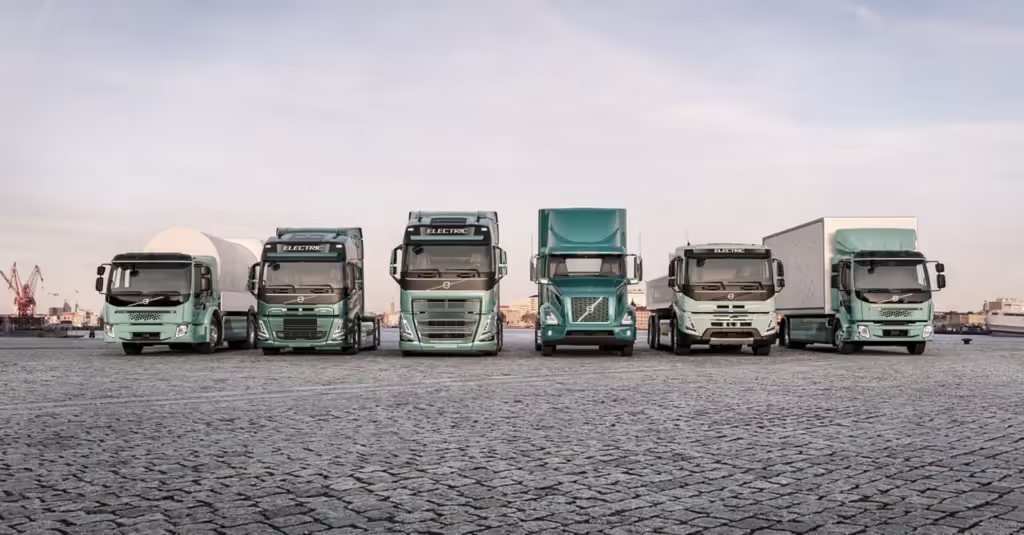
Volvo Group, a Swedish multinational manufacturing corporation, has embarked on an industry-leading journey to become a pioneer in sustainable mobility.
With the ambition to reach net zero in Scope 3.1 by 2040, the Group sought a solution to effectively engage thousands of internal buyers, as well as its vast supplier ecosystem, into sustainable procurement.
The Purchasing department selected CO2 AI to seamlessly integrate expertise and innovative technology to turn their ambitious reduction goals into reality — making progress in weeks, not months.
Measuring Scope 3 across a complex supply chain
Volvo Group faced several challenges in their pursuit of Scope 3 sustainability. First, making accurate estimates of carbon emissions was no small task across the Group’s different entities (incl. Volvo Group Trucks, Bus, and Penta).
Thousands of buyers across 20 countries complete purchases with a network of 50,000 suppliers, themselves located all around the world. To provide a glimpse into the complexity — a single model of truck encompasses thousands of parts built by a vast supplier network.
With such a large scale, there was no single source of truth to compute emissions across the supply chain. Carbon estimates were therefore challenging and difficult to compare, which undermined its ability to influence procurement practices.
From strategy definition to internal buyers enablement
Volvo Group selected CO2 AI to operationalize their decarbonization targets. The process began with bringing together all purchases into the platform to build a reliable baseline on CO2 emissions, which was accomplished in just a few weeks.
In the Volvo Group Trucks division, this involved registering more than 14 million data points between 2019-2023 and connecting them to 2,000 emission factors.
A thousand buyers across continents were then trained and granted access to the CO2 AI platform. They are able to see their supply partner portfolio broken down by part and raw materials.
Buyers can then identify relevant decarbonization initiatives for their suppliers using the CO2 AI decarbonization library. They will be able to track progress of their reduction initiatives within their own portfolio, while the Responsible Purchasing team monitors the impact on the global emission reduction trajectory.
Engaging suppliers to decarbonize at scale
Volvo Group suppliers are expected to contribute to the CO2 reduction roadmap. The ambition is to involve them directly in sharing product-level information with the CO2 AI Product Ecosystem, in a secure and seamless manner. Buyers will extend requests to their suppliers and gather all relevant information in a single location.
Collecting primary data enables Volvo Group to achieve a higher baseline reliability and granularity. This also creates a snowball effect, with providers being encouraged to reduce their own Scope 1 and 2 emissions, as well as to engage their own engineers to embed eco-design practices across the value chain — eventually cascading down the same requirements to their supply chain.
Operationalizing Volvo Group’s Net Zero trajectory
Volvo Group's collaboration with CO2 AI has resulted in significant progress towards sustainability goals. The company has successfully baselined 100% of scope 3.1 emissions at the part and commodity level, providing an accurate and comprehensive understanding of their carbon footprint.
In addition, the Group has identified 120 reduction levers for key commodities like steel, aluminum, and batteries, enabling potential reductions of up to 55% by 2030. Buyers and suppliers are working hand-in-hand to operationalize the roadmap through creating and tracking decarbonization initiatives in CO2 AI.

We have trained 1,000 buyers since 2023 to integrate sustainability as a key pillar in supplier strategy. Buyers are the agents of change, as they are translating Volvo’s sustainability targets into actionable and concrete initiatives to reduce emissions together with our suppliers.

Aurelia Hillestad, Sustainability Manager
Volvo Trucks Group
The accuracy and comprehensiveness of the CO2 AI platform, as well as the expertise from the team, have enabled us to operationalize our complex sustainability efforts. We seek to become the leader in sustainable mobility and are delighted to count CO2 AI as our partners on sustainable procurement to reach Net Zero.

Linn Fortgens, Head of Communications and Responsible Purchasing
Volvo Trucks Group

.svg)
.svg)
.svg)
.svg)

.svg)
.svg)
.svg)
.svg)
.svg)


.svg)
