


Symrise AG, a global supplier of flavors, nutrition ingredients, fragrances, and cosmetics, was at COP 30 recently, where together with CO2 AI, they underscored their strong commitment to climate action and biodiversity. At a TED Countdown House event in Belém, Symrise CSO, Dr. Isabella Tonaco, along with Charlotte Degot, Founder and CEO of CO2 AI, announced the launch of the Houston digital tool, that the two companies have been jointly developing.
For Symrise, sustainability has always been an integral part of their business model. With a Science-Based Targets initiative (SBTi) approved Net Zero target by 2045, including a 30% reduction in Scope 3 emissions by 2030, accurate and scalable product footprinting has become mission-critical for both customer service and sustainability strategy.
The Houston tool, powered by CO2 AI, enables Symrise to measure and manage product- and corporate-level carbon footprints with precision and efficiency. By integrating this carbon data, Houston empowers teams to gain real-time insights, prioritize impactful interventions, and ensure compliance with evolving regulations. The platform’s robust governance structure supports traceability and transparency, reinforcing Symrise’s ambition to advance in scalable decarbonization.
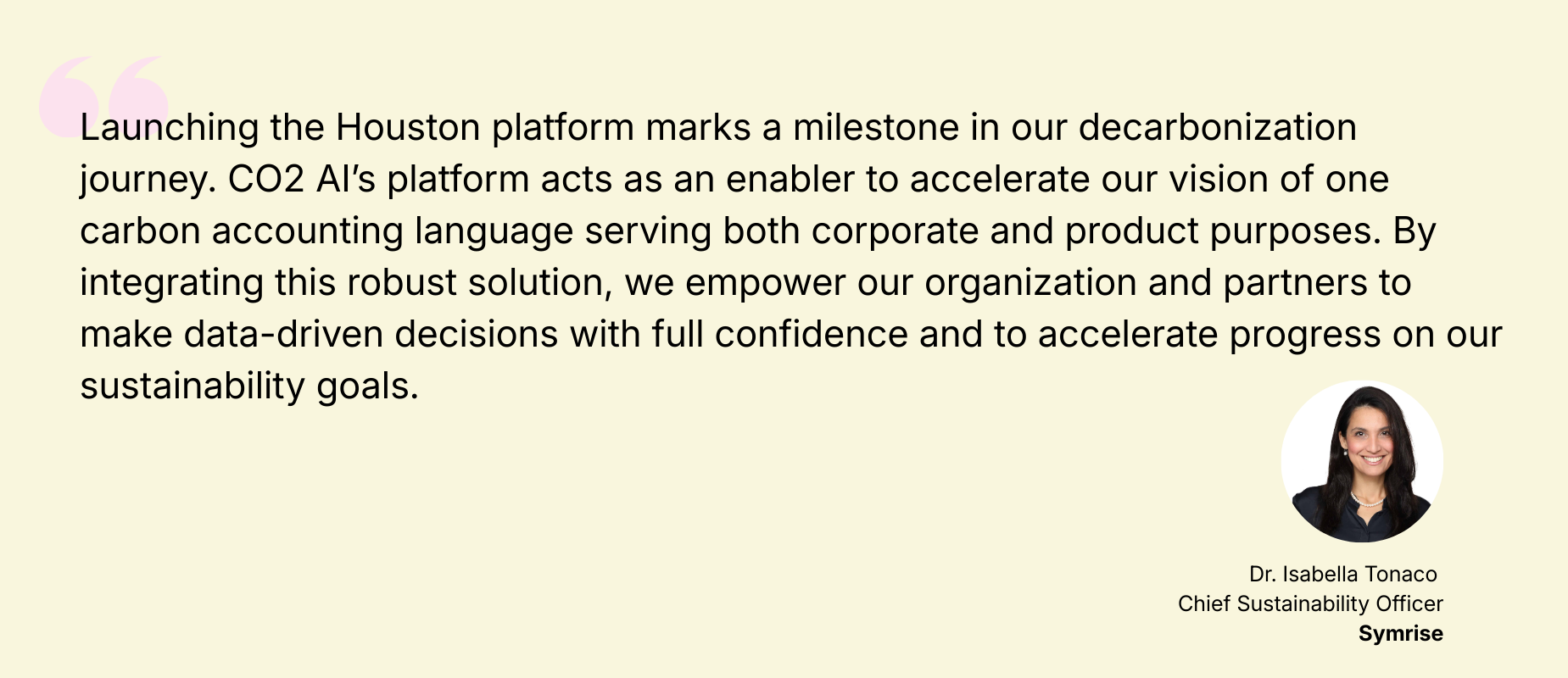
Enabling a shift from reporting to a reduction mindset
CO2 AI's platform integrates both corporate and product-level carbon footprinting, providing Symrise with a unified system for impact measurement and reduction planning. This integration eliminates data silos and ensures consistency across the organization. The changes designed at the product level are automatically reflected in the company's reduction roadmap across Scopes 1, 2, and 3, and vice versa. By connecting measurement to action in real time, Symrise can prioritize interventions that deliver the greatest impact for its product portfolio.
The platform democratizes decarbonization across the organization, enabling product owners, procurement teams, R&D engineers, and sustainability professionals to identify emissions hotspots throughout the value chain and make data-driven decisions that unlock tangible business value. Teams can quickly pinpoint which raw materials, suppliers, or processes contribute most to a product's carbon footprint, transforming what was once a months-long manual analysis into insights available in minutes.
CO2 AI's product eco-design capabilities enable real-time "what-if" simulations at both product and portfolio levels, allowing users to model the carbon and cost implications of reformulations, supplier changes, or process modifications before committing resources to implementation.
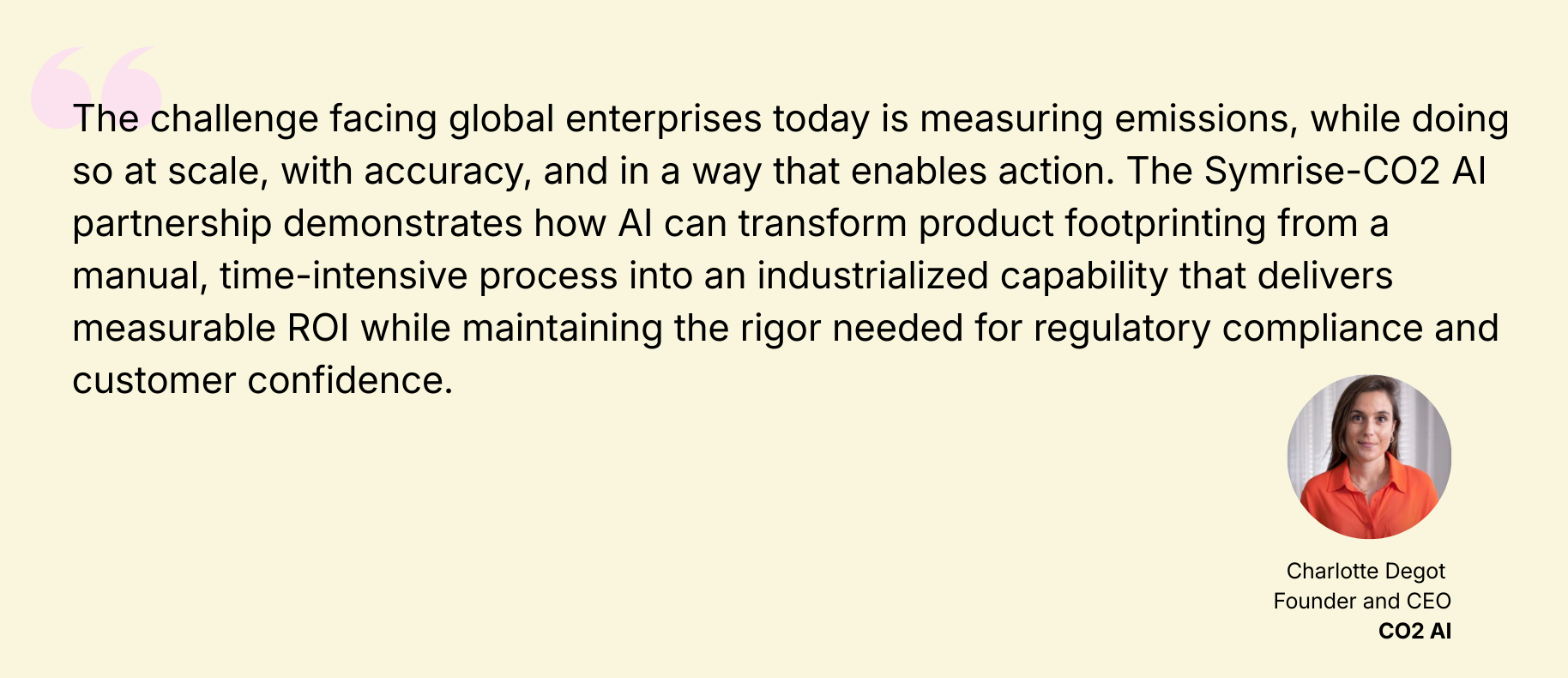
Beyond measurement and planning, the platform provides the governance infrastructure essential for enterprise-scale decarbonization. All data changes, emission factor selections, and computation methods are automatically tracked with full audit trails, ensuring traceability and accountability as Symrise scales its efforts. This built-in rigor is critical for meeting evolving environmental regulations, including the EU's Corporate Sustainability Reporting Directive (CSRD), and for maintaining customer and stakeholder confidence in reported emissions data across thousands of products.


What would you like to read next?