
.svg)


.jpg)
Watch: CO2 AI's Séverine Perrin and Chief Sustainability Officer at The Campbell's Company, Stewart Lindsay, discuss the business case for decarbonization and how AI enables consumers to shop sustainably.
A clock in Union Square
On our first morning in New York, we walked past Union Square and stopped under the Climate Clock. If you haven't seen it, it's an 80-foot-wide display on the side of a building on East 14th Street. In big red digits, it counts down how long the world has left to cut emissions before we lock in 1.5°C of warming. When it first lit up during Climate Week in 2020, it showed just over seven years. This September, it showed less than three.
The clock isn't fixed. It's recalculated as emissions data changes, so it gains time if the world cuts carbon faster. Standing underneath it, watching the seconds drop while the rest of the city rushed past, set the tone for our week. Nobody we met needed convincing about the stakes. What they wanted to talk about was how to move faster with the data, tools and budgets they actually have.
The week in context
Climate Week NYC 2026 brought more than 1,500 events and tens of thousands of people to the city over eight days, running alongside the UN General Assembly. Climate Group chose "Energy" as this year's theme, and it was the right call. Energy security and the cost of living were on everyone's mind. Climate Group's CEO Helen Clarkson also put a name to something many of us had noticed for months: "greenhushing". Companies are still making net-zero decisions. They've just become quieter about them.
Even the weather joined in. Severe storms forced the cancellation of the Global Citizen Festival in Central Park on the final weekend. But inside the meeting rooms, the conversation was firmly focused on how we can accelerate out pace. Fewer people were restating targets, and more were comparing notes on what works and what it costs. Helen Clarkson closed the week with a line that was powerful: "We must turn this economic argument into political courage."
Over four days, we hosted an FMCG leadership roundtable, a reception with Boston Consulting Group (BCG)and a working session on chemical value chains with the American Cleaning Institute. We also sponsored the launch of MIT's 2026 State of Supply Chain Sustainability report. Here's what we heard:
What we heard across the week
- Supplier engagement is still the hardest problem. Progress on exchanging product carbon footprints (PCFs) is slow, much like last year. But the conversation has matured. Instead of chasing PCFs from every supplier, companies are asking which ones they actually need, and how good the data has to be to support a decision.
- Geopolitics is squeezing delivery even though ambition keeps rising. Tariffs and conflict are forcing companies to delay or scale back their sustainability plans, even as their commitment holds firm.
- People want footprints that keep up with reality. Leaders are asking for PCFs that update when a supplier switches to renewable energy or changes where it sources a material, rather than a static number that's out of date by the time it's reported.
- Sustainability link to business value is non negotiable. The ideas that resonated most were ones that tie carbon to margin, revenue or customer retention. Packaging optimization and supply chain visibility kept coming up because the return is easy to see.
Monday: what FMCG leaders can't compromise on 🥫
We wrapped up our first day with an executive roundtable for sustainability and procurement leaders from FMCG companies. We asked the room two questions: what are your non-negotiables for 2027, and what's standing in your way?
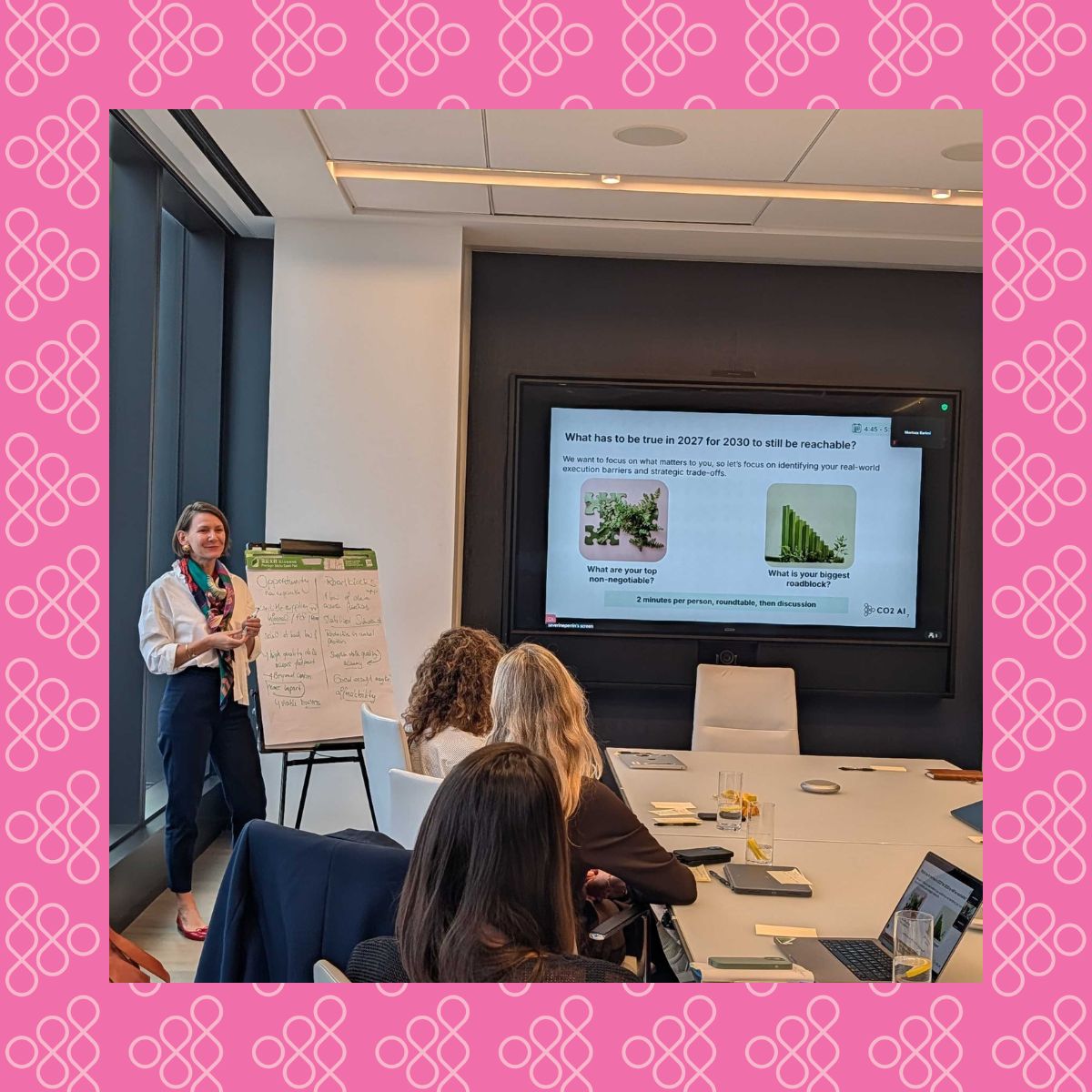
The non-negotiables came quickly. Leaders want credible, high-quality supplier data, whether that's PCFs, life cycle assessments or renewable energy certificates. They want solutions they can deploy now, that make sense on cost and on capability. They want to bring their footprint down without hurting farmer livelihoods or the viability of the business. And several want to look beyond carbon, toward the broader planetary boundaries their supply chains depend on.
The roadblocks were felt by almost everyone at the table. Standards still aren't stable or harmonized, so teams are building multi-year roadmaps on accounting rules that may change underneath them. Organizational change makes it hard to get data used widely inside the business. And the gap that came up again and again: procurement teams and sustainability teams are still collecting and using supplier data separately. That's the gap we need to close as an industry.
Tuesday: AI that earns its keep, with BCG 🤖
On Tuesday evening, we teamed up with BCG to host a reception and panel on how to drive measurable impact with AI in sustainability.
Rich Lesser, Global Chair of BCG, opened the evening with a stark reminder of what's at stake. He spoke about the devastating impact El Niño is expected to have this year, and what that means for communities and supply chains already under strain. Then he turned to the room. In a year when it would be easier to step back, especially given the shifts in climate policy in the US, he congratulated everyone there for still caring, and made the ask urgently: we need to keep decarbonizing.
Séverine Perrin, Head of Customer Impact at CO2 AI, then moderated a panel with Sreedevi Rajagopalan, Director of the MIT Sustainable Supply Chain Lab, Yupu Zhao, VP Global Sustainability Strategy at PepsiCo, and Mortaza Karimi, VP Revenue at CO2 AI. She set it up with a point most people in the room recognized. Almost every large company has run an AI pilot in sustainability, but very few have anything running at scale. And the gap between the two isn't really about technology. It's about data, trust and how organizations are set up.

Yupu brought the most concrete examples. PepsiCo is working with hyperscalers on digital twins of its plants and warehouses, so teams can test decisions like adding a production line or more storage before spending any money, while weighing carbon, water and waste alongside performance. In the field, PepsiCo works with farmers in around 60 countries. One AI tool lets a farmer photograph a potato crop, spot emerging problems through pattern recognition and get a recommendation back, putting expertise that used to depend on a site visit directly in the farmer's hands. It supports PepsiCo's ambition to spread regenerative agriculture practices across 10 million acres by 2030.
Yupu was also refreshingly honest about where his team started. PepsiCo's sustainability function was initially wary of AI because of the energy and water footprint of data centers. So they ran the numbers. Their direct AI footprint turned out to be very small relative to their total emissions, and that, combined with training, hackathons and real change management, turned the team from skeptics into leaders. They have since built tools like a scenario agent that models how adding recycled plastic, or investing in Scope 1 and 2 reductions, would change their climate trajectory.
Mortaza widened the lens to what CO2 AI sees across its clients. The use cases that deliver tend to be the least flashy: optimizing energy use at plant level, and making fragmented operational data trustworthy. Most large manufacturers run several ERPs, local systems and a lot of spreadsheets. Scope 3 is where that mess hurts most, but it isn't just a sustainability problem. The same data drives procurement decisions, packaging and EPR exposure, manufacturing waste and supplier risk. Once AI has cleaned it up, categorized it with a full audit trail and filled the gaps transparently, every decision built on top of it becomes easier to make with confidence.
Asked what holds companies back, Mortaza pointed to poor data, not knowing which use case to start with, and the specific know-how agentic AI demands, from evaluating performance to managing cost. His advice for anyone starting tomorrow: go narrow. Don't try to equip the whole company at once. Pick a use case with a clear business outcome sitting next to the sustainability one, because that's what gets it funded and adopted internally. And then allow yourself to be bold about where you point it.
Check out our Applied AI uses cases.
Wednesday morning: MIT's 2026 State of Supply Chain Sustainability 📊
The next morning, we joined the MIT Center for Transportation and Logistics at the Dream Hotel for the launch of the 2026 State of Supply Chain Sustainability report.. Sreedevi moderated a panel with Séverine, Philippine de T'Serclaes, Chief Sustainability Officer at Dassault Systèmes, Rachel Schwalbach, VP of ESG at C.H. Robinson, and Heather Ewing, VP Enterprise Solutions at Breakthrough.
.jpg)
The report's headline findings gave the conversation its shape. The hardest challenges companies report today are about visibility, data integration and supplier compliance, ahead of energy and waste. AI is now firmly part of the work, mostly to estimate emissions where supplier data is missing and to bring together data scattered across systems. But better measurement hasn't yet turned into better decisions. Only about a quarter of companies use AI to model what would happen if they changed something.
That gap ran through the whole panel. Séverine was asked where the quick wins for AI are today, and what separates companies that use it to measure carbon from those that use it to reduce it. Philippine explored how virtual twins can help companies compare options earlier, at the design stage, and how to make the case to a CFO. Rachel tackled one of the report's sharpest tensions in freight: customers are already demanding cleaner transport, so why hasn't that changed what's in the tank? And Heather made the case for treating freight decarbonization as a portfolio of solutions chosen lane by lane, rather than waiting for a single winning fuel, especially when policy changes faster than the life of a truck.
Read the key insights in our MIT report highlights.
Wednesday afternoon: chemical value chains, halfway to 2050 🧪
We closed our week with Halfway to 2050, a working session co-hosted with the American Cleaning Institute, with Together for Sustainability (TfS) and the Partnership for Carbon Transparency (PACT). The room was full of people who sit on both sides of the problem: suppliers being asked for PCFs, customers asking for them, and many companies doing both at once.
.jpg)
Emily Trentacope, VP Sustainability at ACI, framed the challenge around two constraints. The first is comparability: when measurement isn't harmonized between suppliers and customers, nobody is sure whether the data can be compared or acted on. The second is capacity: data requests are arriving faster than suppliers can answer them well. Aneta Wierzynska of PACT and Danielle Warnock of TfS then walked through how their standards work together to cut duplication, and what it takes to move from collecting PCF data to using it.
The conversation Mortaza moderated between Kenneth Allinson, Deputy Chief Sustainability Officer at Nouryon, and Lullit Jezequel, Supplier Climate Action Manager at The Clorox Company, brought both sides of the exchange into one discussion. Ken described what it's like to sit in the middle of the value chain. Some customer requests are little more than box-ticking. Others feed Scope 3 reporting. The best ones are used to find real innovation and decarbonization opportunities. His advice to the room was to stop sending broad, one-size-fits-all questionnaires and invest instead in deeper conversations with priority suppliers. Start with the materials that matter most, agree on the decision you're trying to make together, and use NDAs where needed so both sides can share more.
Lullit shared how Clorox is approaching it from the buyer's side: focus first on suppliers of the highest-emitting materials, send clear and standardized requests aligned with PACT, start with the data that exists today and improve it over time. She described how SPARC, CO2 AI's supplier program, is helping Clorox scale primary data collection while building suppliers' ability to respond in a consistent, audit-ready way. And she shared a milestone: Clorox's first RFP to include PCFs as a decision criterion, in its fragrances category. Carbon isn't yet tied directly to price, but the signal to suppliers is clear. Her closing advice: tell your suppliers their data will be used for collaboration and decisions, not just reporting, and back that up by embracing standards and accepting progress over time.
Looking ahead
We left New York with a clear sense of where things stand. The ambition is still there, even if fewer people are saying it out loud. The hard part now is turning supplier data into decisions, and getting procurement and sustainability teams working from the same numbers. AI is helping massively and the companies making progress are the ones tying every use case to a business outcome.
And the clock in Union Square keeps counting.
.jpg)
.jpg)
.jpg)


.svg)

What would you like to read next?